English ? Guide
영어의 맛을 느끼세요: Emotions와 Feelings의 차이
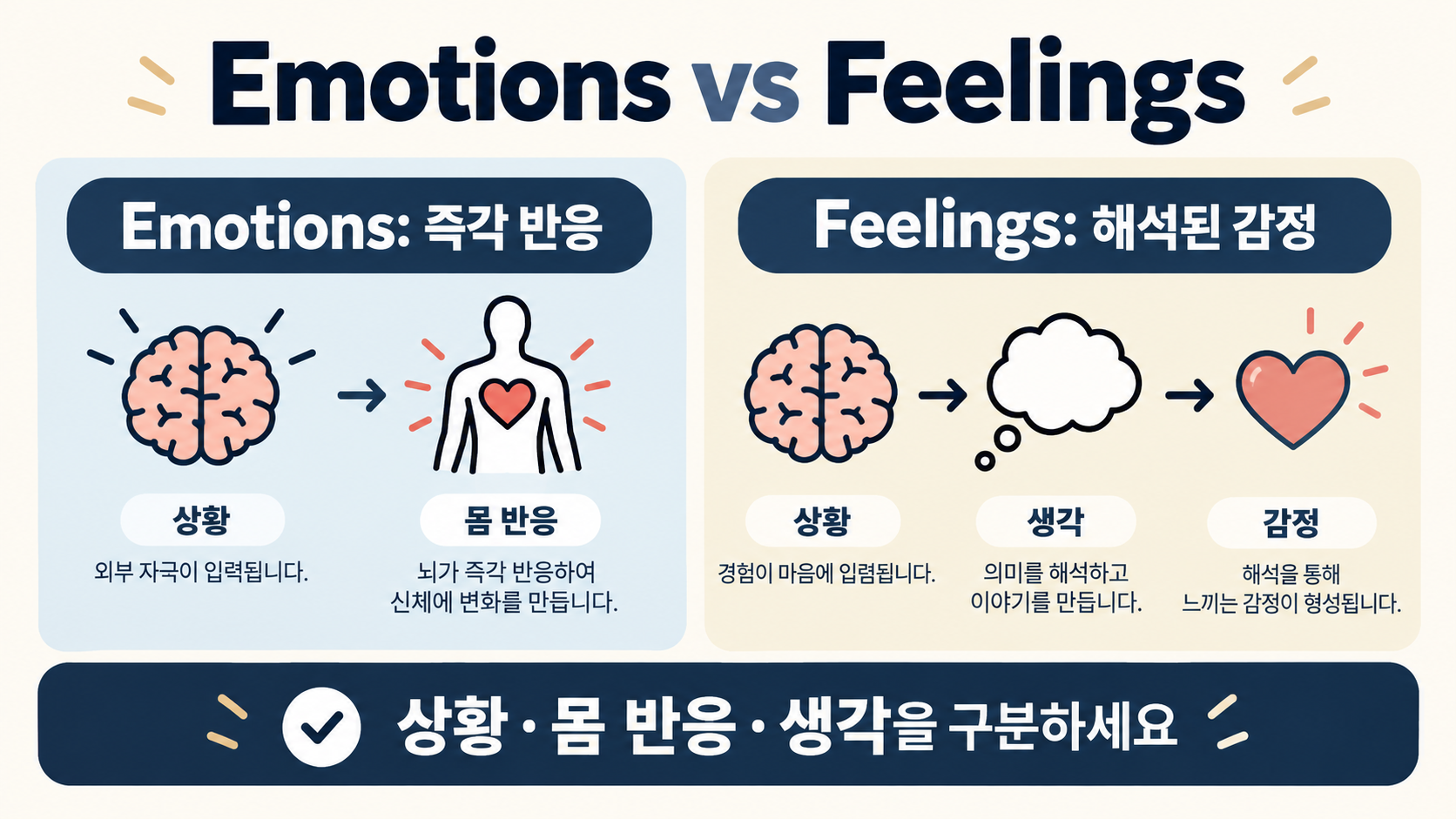
The practical difference begins with context
Both words are often translated as emotion, but English speakers use them with different centers of attention. Emotion commonly points to a recognizable emotional response such as anger, fear, surprise, relief, or joy. Feeling can include a personal impression, an attitude toward something, a bodily sensation, or a hunch. The boundary is not a rigid scientific line, because research traditions define these terms in several ways. For everyday communication, it is more useful to ask what the sentence is trying to describe than to search for a single permanent translation.
When emotion is the clearer word
Use emotion when you want to discuss a response as a type, a pattern, or something visible in behavior. A film may stir strong emotions, a person may hide emotions, and a stressful event may produce intense emotions. These examples place attention on the emotional response itself. The plural form is especially common when several reactions are present at once. This does not mean that every quick reaction must use emotion, but it is a helpful default when the sentence sounds analytical, descriptive, or concerned with emotional regulation.
When feeling is the clearer word
Use feeling when you are talking about a private sense of what something means to you. I have a strange feeling about this plan can describe an uneasy hunch. My feelings were hurt can describe a personal wound in a relationship. Feeling also has a non-emotional meaning in sentences such as I lost feeling in my fingers. That range is exactly why context matters. Before translating, decide whether the speaker means an inner impression, a bodily sense, an opinion, or an emotional reaction.
Separate event, body signal, and interpretation
A useful observation exercise has three parts. First name the event without judging it. Then notice a body signal such as a tight chest, a quick heartbeat, warm cheeks, or a tense jaw. Finally identify the thought that arrived with the signal. This sequence prevents one broad word from carrying too much meaning. When I heard the news, I felt scared describes a quick response. After thinking about it, I had mixed feelings describes the more reflective state that followed.

Compare common English expressions
Please control your emotions can sound natural when someone means visible anger, tears, excitement, or agitation. Please control your feelings can sound much more personal because it may appear to demand control over someone?s inner life. Talk about your feelings is usually warmer and invites someone to share thoughts or hurts. His emotions changed quickly describes shifting reactions, while my feelings about the job changed describes a changed attitude toward a particular subject.
Why the verb feel is broader than the noun feeling
In I feel happy, feel is a verb and happy is an adjective. The sentence does not require the noun feeling. In I feel that the answer is wrong, feel is close to think or believe. The verb is flexible enough to connect sensations, opinions, and emotional states. The noun feeling appears in familiar groups such as a feeling, hurt feelings, and mixed feelings. Learning these clusters makes natural choices easier than memorizing one Korean gloss beside each word.
How to describe mixed reactions
One event can create more than one response. I have mixed feelings about moving abroad can express excitement and worry together. Mixed emotions is also possible, but it can sound slightly more analytical in some settings. Neither phrase is a grammar test with only one correct answer. Choose the expression that matches the relationship, the purpose of the conversation, and how personally you are speaking. Adding a reason after the sentence often makes the intended meaning clearer and kinder.
A short self-check for intense moments
When a reaction feels large, pause before trying to find perfect vocabulary. Take a slow breath, observe the body, write down the first thought, and choose one small next action. Drinking water, taking a short walk, or telling a trusted person can be enough. Useful starter sentences include I feel nervous right now, I have mixed feelings about it, and that comment hurt my feelings. Precise language helps communication, but it is never a replacement for support when someone is overwhelmed.

Practice with small, specific sentences
Practice by writing two sentences about the same event. In the first sentence, describe the immediate response: I felt relieved when the meeting ended. In the second, describe what remained after reflection: I still have mixed feelings about the decision. Add one concrete body signal or action if it helps. This practice makes the contrast visible without forcing an artificial rule. The goal is not to label every inner experience perfectly, but to say enough for another person to understand.
A respectful way to talk about inner experience
Tone matters as much as vocabulary. Telling another person that they should control their emotions may sound blaming in a vulnerable moment. A sentence such as I can see that you are upset, or do you want to talk about how you feel, leaves room for the other person?s experience. When speaking about yourself, I felt hurt when I heard that is often less confrontational than a direct accusation. Good emotional language is accurate, specific, and considerate of the listener.
A final summary for everyday English
Emotion is often useful for a recognizable emotional response, while feeling can cover personal impressions, attitudes, hunches, and physical sensation. The overlap is real, so context remains the final guide. Notice the event, the body signal, the thought, and the relationship in which you are speaking. With repeated small examples, the difference becomes a practical choice rather than a confusing vocabulary rule.